
15.06.2026


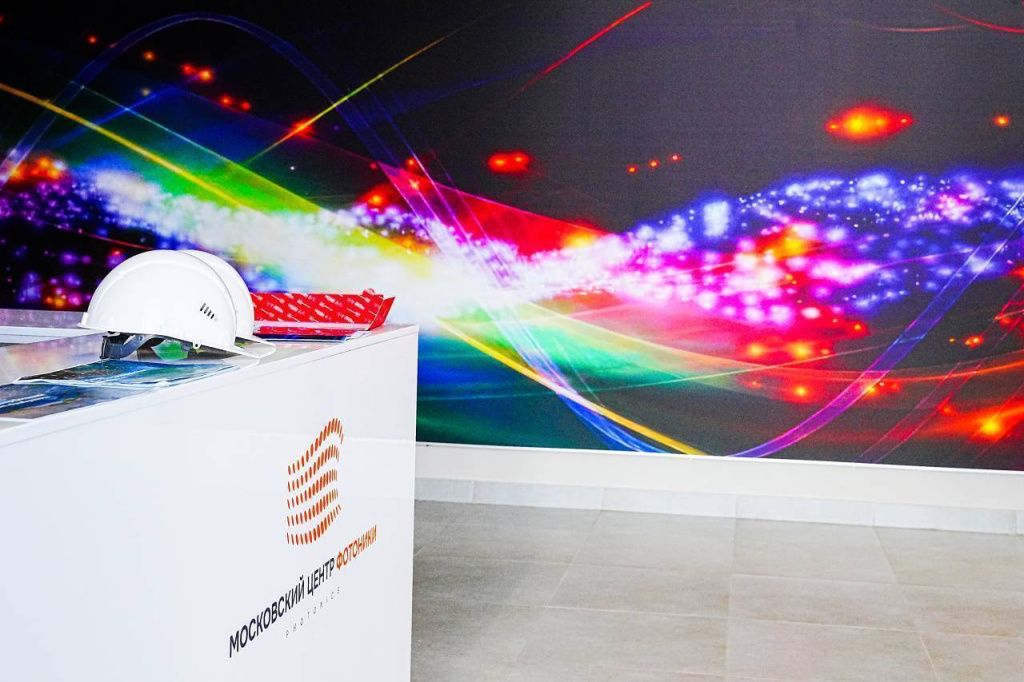
Technopolis Moscow, a resident of the Technopolis Moscow Special Economic Zone, is located in Zelenograd and is the only enterprise in Russia engaged in the production of photonic integrated circuits. Vechernyaya Moskva visited the factory and found out how to create equipment for modern telecommunications and new computing platforms.
The Moscow Photonics Center is at the stage of launching the production of photonic integrated circuits (FIS). What are photonic integrated circuits? These are devices that convert an optical signal into an electrical one, and vice versa. The circuits built into the transceivers will provide data transmission at speeds of over 100 gigabits per second with a significant reduction in power consumption.
Strict rules
As you approach the center, you immediately notice the unusual, angular shape of the bright red building. Evgeny Danilkin, Deputy General Director, meets us at the entrance.
— It is important to follow a large number of rules, since the production of photonic circuits is a painstaking and long process. The production of one product takes up to three and a half months," he emphasizes.
We go into the room, where we put on a protective jumpsuit, thick shoe covers that cover the entire leg and resemble "moonwalker boots", a cap, rubber gloves, and a mask. In front of the clean area, we blow through the airlock so that not even a speck of dust remains. By the way, employees of the company are even forbidden to apply makeup.
— Such measures are explained by the fact that even the smallest particle of skin can affect the quality of the finished product. For comparison, the typical size of a circuit element is 0.2 microns, and a particle half that size can disrupt the circuit and lead to a marriage. To get a better idea of the scale: the diameter of a human hair is about 70 microns," explains Eugene.
Clean zone
Other employees meet us in the clean area. There is nothing superfluous around, just white walls and a long corridor. There are rooms with different classes of cleanliness that meet international standards. For example, in a room with ISO 5 class, the air is updated with special filters about 350 times per hour.
"This is where the equipment for processing silicon wafers is located, on which photonic integrated circuits are formed," Evgeny points to a huge production complex.
Crystal production
The production of circuits is a multi—stage cyclic process in which the thinnest layers are applied to the silicon on the insulator plate and waveguides, resonators, multiplexers, couplers, modulators and photodetectors are formed. First, the plate is cleaned with solutions, then an insulating film is grown by thermal oxidation. Next, photolithography: applying a photoresist, exposing through a mask and developing — this is how a drawing of future elements is obtained on the plate. Then etching is carried out (removal of unprotected areas) and impurity ions are introduced to create areas with different conductivity in the waveguides. For example, the liquid treatment process looks like this: the plate is immersed in a bath with a solution to remove organic pollutants, oxides or metal layers in order to prepare the surface. There is an optical inspection on the site, which identifies defects.
— In most cases, we treat systems with aggressive compounds and acids. But all this happens as safely as possible for employees," Maxim Lazunin, an engineer and technologist of liquid processes, emphasizes.
The next place is the area for applying photoresist, a photosensitive material used to create precise topological patterns. Then exposure is performed — projection from the photomask onto the surface of the plate.
— The process is a bit like printing photos taken on a film camera, — explains Evgeny.
Indeed, the lighting in this area is different from the previous ones: the light here is orange. Specialists apply a photoresist to a plate, then place it in a drying oven, then into a scanner that projects a pattern onto the surface. Square sections can be distinguished on the plate — these are frames (exposure fields), and there can be from 40 to 130 of them, depending on the size of the chip. We are moving to another room, where there is a large fleet of technological equipment.
— Here we etch the layers of plates. This is necessary to create a clear topological pattern in the layer and to form a photonic integrated circuit," says technological engineer Andrey Stupin.
The large loading gateway attracts attention.
— Cameras are connected here, allowing you to separate the production processes and not mix different materials that can lead to contamination of the plate, — explains Andrey.
"We have a cyclical production process, so products can be returned at some stage," adds Evgeny.
The entire cycle — lithography, etching, alloying, deposition — is repeated dozens of times, after which the plate is tested and cut into individual chips.
A unique company requires unique specialists. I am interested in finding a sufficient number of qualified employees.
— Today we have managed to assemble a team of 100 specialists, but we plan to double our staff. It is very difficult to find employees because of the narrow profile of the specialties, so the process is not fast, - says Evgeny.
The center plans to expand production and produce up to 500,000 circuits per year.
The material was prepared by the Evening Moscow edition.
Press Service of Technopolis Moscow SEZ
+7 495 647 08 18 (ext. 1209) pr@technomoscow.ruFollow Technopolis Moscow SEZ on social media, stay updated with the main SEZ news on our Telegram channel, and receive all important updates directly to your inbox via our weekly newsletter.


