
24.03.2026


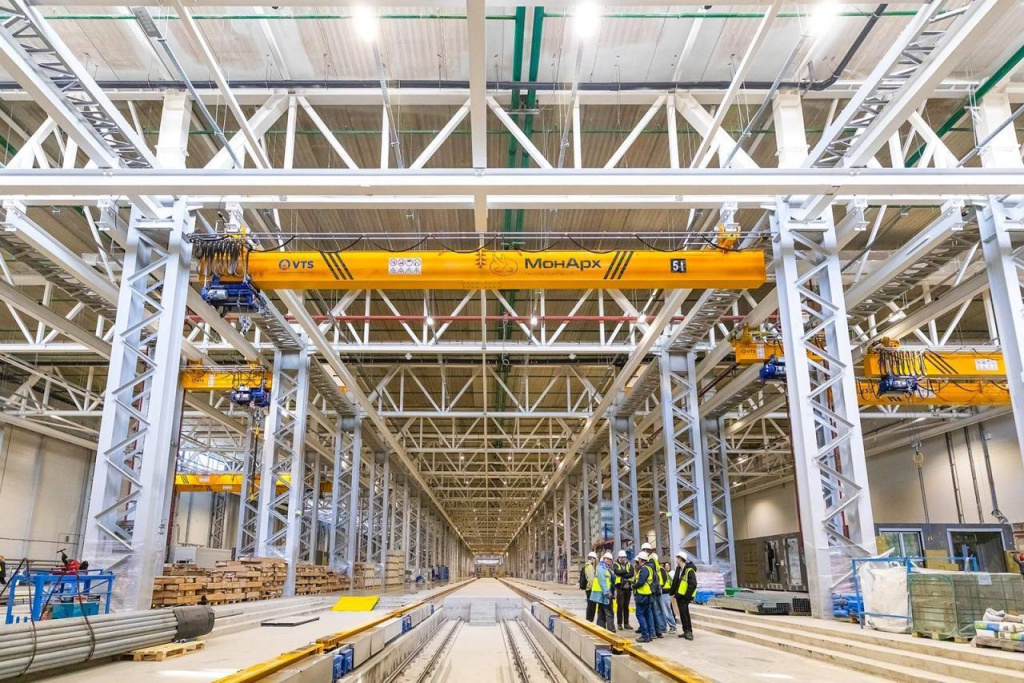
Modular construction allows you to assemble a room, an apartment, and even an entire floor of a factory house. This unit has walls, floor, ceiling, windows, doors and all necessary communications.
Moscow is the largest industrial center of Russia. Enterprises of the machine tool industry, instrument engineering and aircraft industry operate in the capital, a pharmaceutical cluster has been created, the flagship of the high—tech industry, the Technopolis Moscow Special Economic Zone (SEZ), is actively developing, and much more. At the same time, they not only produce products, but also introduce citizens to all stages of production. Traditionally, within the framework of the project "Open#Mosprom" Moscow enterprises invite residents and guests of the capital on excursions.
The project unites over 150 metropolitan industries. This year, the world's most modern and largest modular housing construction plant, Monarch Combine of Innovative Technologies LLC, a resident of the Technopolis Moscow special economic zone, joined it.
The correspondent mos.ru I went on an excursion to the workshops and learned what modular construction is and how future bedrooms, living rooms, kitchens and bathrooms are made and assembled using massive pallets, robotic machines and lifting mechanisms.
Prefab technologies and first records
The plant is located in the Vnukovo district (48th block, building 2, building 10). You can recognize it by the multi-storey gray buildings with orange stripes on the facades. The workshops assemble large—sized modules for the construction of residential buildings, administrative buildings, schools and kindergartens - both individual rooms and spaces, as well as entire apartments. More than 1,600 employees take over the service in shifts.
Prefab technologies are at the heart of production. They allow you to manufacture parts of buildings — walls, panels, or entire apartment modules - at the factory in order to bring them ready—made and assemble them on the construction site.
"The first floors of new buildings are traditionally high, they are built in a classic monolithic way. And the rest are modular, and their height is strictly regulated. This is due to the fact that the modules need to be transported around the city: drive under a bridge or in tunnels, in limited spaces. At the site, the building is assembled from imported modules using cranes. At the same time, we can deliver eight modules to the construction site, and this is an entire floor," says Andrey Sukholentsev, Head of Marketing at the Monarch Innovative Technologies Plant LLC.
The plant has been operating for the third year, but already boasts the first records. In 2023, a module with an area of 116 square meters was produced here — the largest in the world. The achievement was included in the Russian Book of Records, and the module itself is located on the territory of the plant, not far from the main entrance.
"Another of our achievements is the construction of a house under the renovation program on Garibaldi Street. It became the tallest building of all that we built. It has 23 floors. In addition, this house is the first building built under the renovation program with modular technology. Thanks to her, the new building was built in record time — in six months. The house has already been commissioned and is being occupied," notes Andrey Sukholentsev.
The tourists gather at the main entrance and, after listening to the briefing, go to the largest building of the plant — the main building. At first glance, the space doesn't look like a factory. Sunlight pours from the panoramic windows, and small loaders quietly ply along the long paths of the spacious halls.
"We care about the environment. We have much lower carbon emissions than a classic construction site. And we care about people. Our workshops are comfortable, clean and warm, and robotic technologies help us work," adds Andrey Sukholentsev.
Concrete, metal and mineral wool
The first point of the route is the reinforcement shop. We go up to the second floor, where dozens of machines and mechanisms are located under high ceilings. Bogdan Kaloshin, a specialist from the plant's chief mechanic department, meets us near one of them.
"At the reinforcement section of the plant, the steel frames of the modules are being forged, structures that give them reliability and strength. Domestic equipment is used for their manufacture," says Bogdan Kaloshin.
First, the reinforcing coils (coils) are loaded onto special unwinding devices. They spin, straightening the rebar like a light wire. Then, on a small machine, according to the drawings, rods of the required length are cut off from it and connected to each other using an adjacent installation with a welding mechanism. Thanks to modern technologies, welding takes just a couple of seconds: a small press is lowered onto the parts and, like a stamp, holds the elements together due to high pressure.
"After the reinforcement is placed in the bending machine. On it, with the help of a large shaft, it bends, forming a three—dimensional structure - a spatial frame. It serves as the basis for the walls of future modules," adds Bogdan Kaloshin.
In the next section, the sound of machine tools is replaced by the soft thud and grind of hand tools: cutters, hammers and sledgehammers. The steel frames are placed on huge iron pallets. Where necessary, the spaces between the bars for insulation and sound insulation of future walls are filled with mineral wool. It does not burn, does not absorb moisture and does not emit harmful substances. The places where communications are planned to be installed in the walls are filled with foam to preserve them when pouring concrete.
High-strength concrete is used. It is poured into steel frames using a concrete paver. There is a buzzing sound. Vibration is applied to the pallets so that the concrete is evenly distributed. After that, the structure is sent to dry in a huge oven. When the concrete has solidified, the foam is removed, freeing the holes for communications, and then the blocks are transported along the conveyor to the neighboring site.
At the same time, experts manually assemble sanitary cabins on the second floor of the plant. Floors are made of iron frames and concrete, partitions are installed, waterproofing is performed, tiles are laid and plumbing is installed. The future bathroom or shower room, which is almost 95 percent ready, is lowered to the floor below and installed in a concrete module. The apartment is on the way
The site of the workshop where the modules are assembled is referred to by specialists as kilometer zero. It is here that, like the details of a designer, reinforced concrete blocks are connected with reinforcement, creating rooms for future apartments.
When the walls are installed, specialists fill in the concrete floor, lay communications, place sockets, install windows and doors, creating a 90 percent finished apartment in a matter of hours. The assembled modules are loaded onto huge trawling machines and taken to construction sites.
"Thanks to the modular technology, it was possible to significantly reduce the work time. With its help, we build buildings almost three times faster than with monolithic house construction. We are currently producing one module in two hours, but in the future we plan to reach full capacity and reduce this time to 45 minutes. The city motivates and supports us in this," notes Andrey Sukholentsev.
The plant received land for the construction of buildings under the program to support large-scale investment projects in 2019. The city allocated a preferential loan to the investor and provided benefits, which made it possible to complete the construction of the first stage of the plant in 2023, and the second and third in 2025. In addition, due to the status of a resident of the Technopolis Moscow SEZ, the company is exempt from paying property, land and transport taxes for 10 years, and the income tax rate is two percent instead of 25.
Egor Balashov, a participant in the tour, is following the progress of work in the workshops of the plant with special attention. He is in the 10th grade of school No. 1950 and dreams of connecting his life with engineering.
"I became interested in the technology of building modular homes and decided to take part in an excursion of the project "Open#Mosprom”. And it became a valuable experience. It was interesting to look at the filling process, to see how the modules are assembled. In the future, I want to go to a construction university, and the tour allowed me to make sure that I really like this field," says Egor Balashov.
Another participant, 37-year-old Svetlana Markina, was very impressed by the tour.
"I am a veterinarian by profession, and the construction industry is unfamiliar to me. The other day, my husband and I were visiting our parents and saw a construction site from their window. Mom shared how quickly a house is built, literally in months, assembling floors like cubes. And then I saw that in the project “Open#Mosprom” is planning a tour of the plant, which is engaged in construction. I decided to go. It was useful to learn how to build houses from modules. I will be happy to take part in other excursions of the project," the interlocutor emphasizes. mos.ru.
Press Service of Technopolis Moscow SEZ
+7 495 647 08 18 (ext. 1209) pr@technomoscow.ruFollow Technopolis Moscow SEZ on social media, stay updated with the main SEZ news on our Telegram channel, and receive all important updates directly to your inbox via our weekly newsletter.


