
14.12.2025



Robot development and production is one of the most promising sectors, the development of which will largely determine the shape of Moscow's industry in the coming decades. Currently, approximately 25 companies operate in this sector, producing robots used in industry, agriculture, warehouse and rescue operations, and other fields. Sergei Sobyanin described how the city is supporting the development of the industry in his blog.
"The Moscow government offers development companies a comprehensive support system, including both financial and non-financial instruments. Specifically, the Moscow Fund for Support of Industry and Entrepreneurship will reimburse up to 50 percent of the Central Bank's key interest rate on investment loans of up to five billion rubles," the Moscow Mayor wrote.
Furthermore, the Moscow Guarantee Fund will reimburse up to 70 percent of loan proceeds. And through the Moscow Innovation Cluster's i.moscow platform, you can receive a grant of up to 30 million rubles for equipment purchases, leasing, or interest reimbursement.
Technopolis Moscow SEZ: Resident Support and Workforce Training
The Technopolis Moscow special economic zone (SEZ) plays a key role in the development of the robotics industry.
Resident companies can significantly reduce their tax burden. For example, they are exempt from property, land, and transport taxes for 10 years, pay only 2% in profit tax instead of 25%, and are also exempt from customs duties and VAT on imported equipment.
Furthermore, the Technopolis Moscow SEZ is a training ground. Since last year, a flagship practical training center for colleges has been operating at the Rudnevo site, where over 3,000 students annually study industrial specialties.
This fall, the "Professions of the Future" practical training center opened in Pechatniki, where adults can master in-demand professions and college students can undergo academic and industrial internships. The center will graduate 15,000 qualified specialists annually.
Young professionals can also complete internships at leading companies through the Technostrenderovka project, gaining real-world skills in high-tech industries, including robot development and production. Since 2022, 3,200 people have participated in the program.
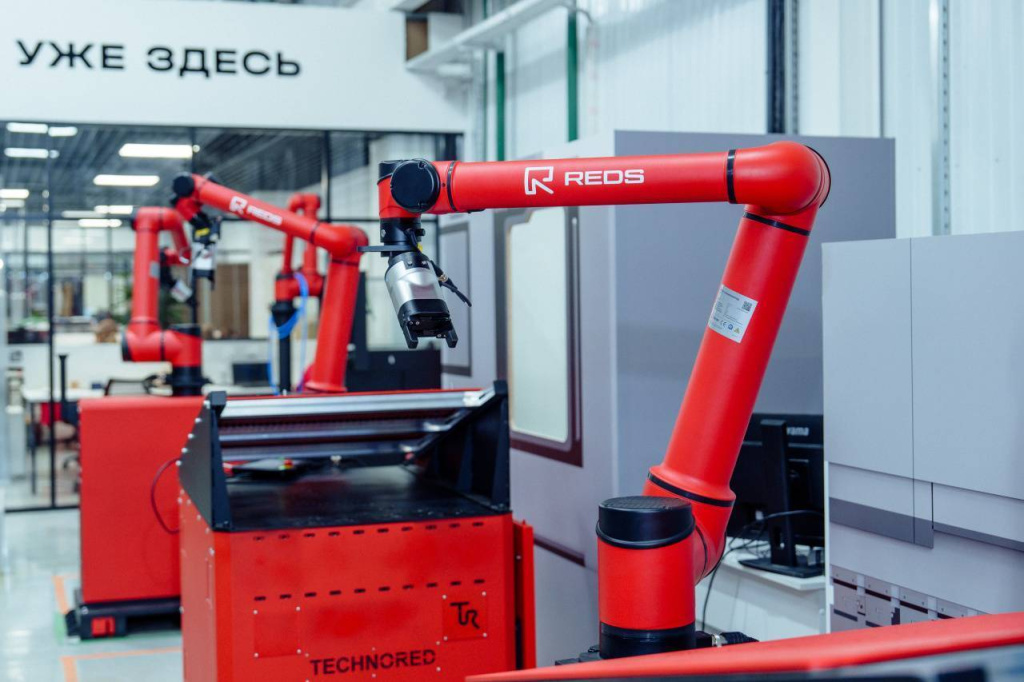
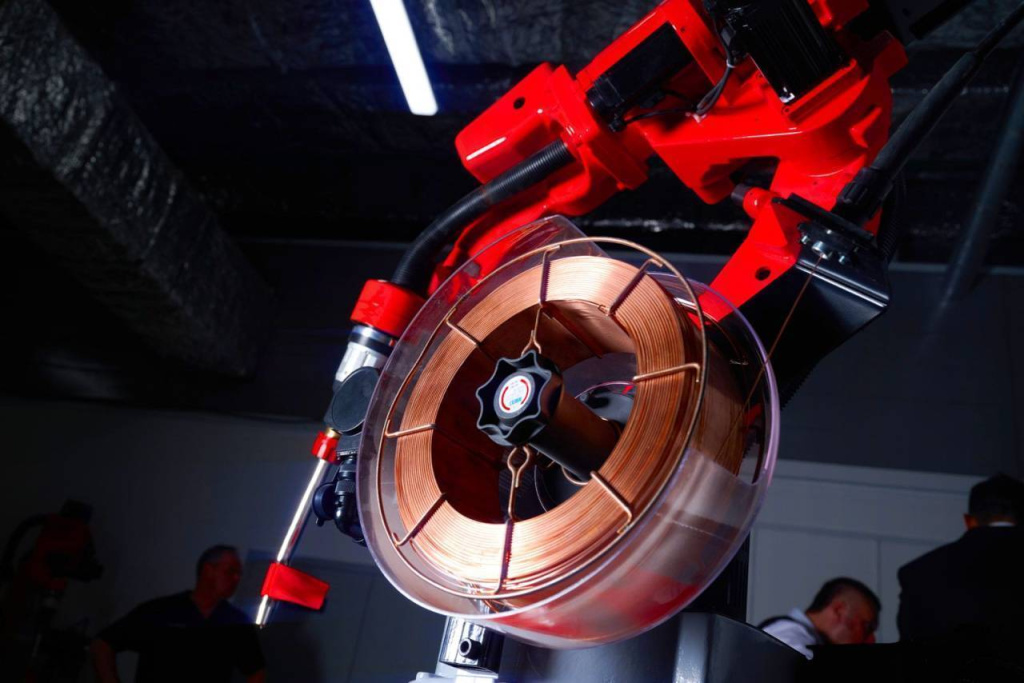
In May of this year, TechnoRed opened its robotics center in the Technopolis Moscow SEZ. The company manufactures industrial robots, robotic systems, and associated software. These solutions are used to automate a number of key manufacturing operations, including welding, palletizing, stacking, machine loading, and more. By 2030, the resident company plans to produce at least 25,000 robots. These devices are already being supplied to companies in Moscow and dozens of other cities across Russia.
The company recently patented a device that automates button presses on a control panel. This solution allows its clients to improve production efficiency, reduce human error, and perform monotonous and repetitive tasks without human intervention.
Technology Parks: Modern Production Facilities and Robot Development
To scale up production in the capital, a network of technology parks has been created. They provide companies with modern infrastructure and access to support measures, including tax breaks, grants, subsidies, as well as consulting and training programs.
Currently, 49 technology parks operate in Moscow. Their residents can take advantage of the support offered by the Moscow Innovation Cluster. Management companies and anchor residents are eligible for an investment tax deduction. They are reimbursed up to 90 percent of the costs of equipping their production facilities using the regional portion of the income tax (13.5 percent).
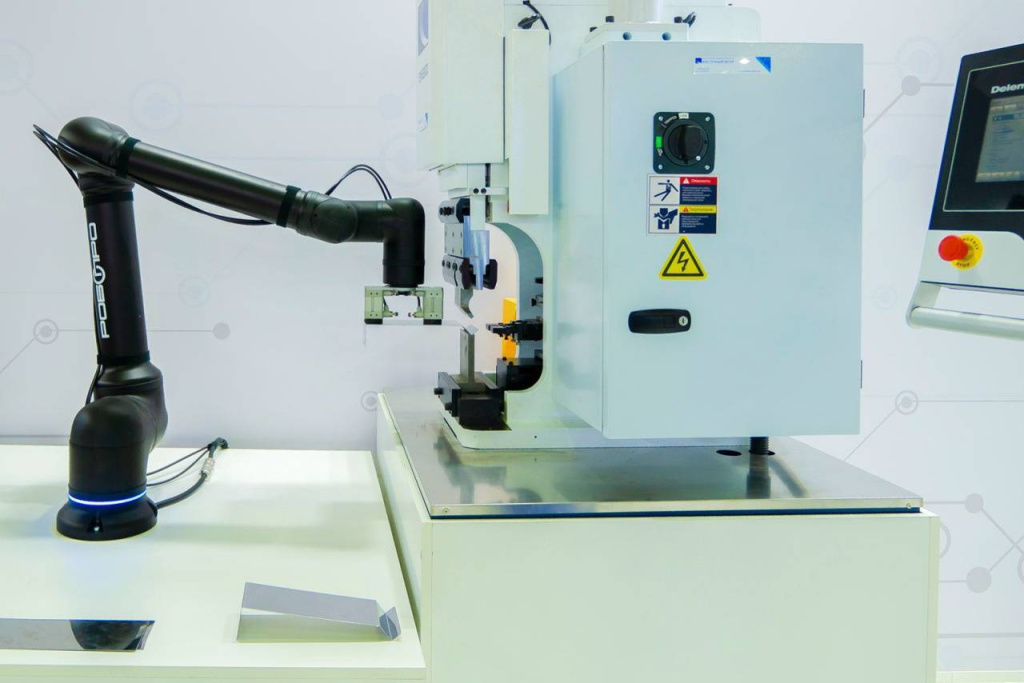
Recently, at the Mosgormash Technology Park, Robopro mastered the production of collaborative robots used to automate routine production tasks. The company plans to produce over a thousand units of equipment annually, and up to five thousand robots per year by 2030.
Another resident of the Mosgormash Technopark, Aripix Robotics, specializes in creating robotic systems and software that reduce manual labor. For example, a robotic cookie-packing system was created for the United Confectioners holding company. It can pack up to 42,000 cookies per shift—almost twice as many as a 12-person team could handle.
Other developments from this company are also successfully used in food production, including an automated tea bag packing line. Its key advantage is its ability to handle a wide range of products. For example, it can pack up to 15 different types of tea.
Bitrobotics, a resident of the Elma-Semenovsky Technopark, creates high-tech equipment and comprehensive solutions for automating processes in the food industry. Among its developments is the Vatrushkomat, a robotic system for producing cheesecakes. A robotic arm photographs dough pieces on a baking sheet, accurately locates the center (with an accuracy of no more than a millimeter), forms the doughnut, applies the egg mixture, and adds the curd filling—the dosage is controlled down to the gram. It produces 18 doughnuts per minute. This robot is currently working at the Cheryomushki confectionery and bakery plant.
Nevlabs, a Skolkovo resident, also produces robots for the food industry. The company has delivered approximately 50 units of this equipment. Among its customers is Meridian, a major producer of fish and seafood products. The robots assist in placing products in primary and secondary packaging. The throughput reaches 150 items per minute. One robot can replace up to four people.
Ronavi Robotics, a Rusnano Group company, is implementing its robotic solutions in various industries, from warehouse logistics to the automotive industry. At its Vostok-Service warehouse in Ramenskoye, the company launched a fleet of 48 mobile robots, connected by an intelligent control system. As a result, picking individual orders has become five times faster.
In the automotive industry, the company's solutions have helped automate the transportation of parts between the assembly line and the paint shop. No infrastructure redesign was required: the robot automatically plots its route, avoids obstacles, and returns to its base after completing its task.
Robots from Robotic Management Systems (also part of the Rusnano Group) take on routine cargo transportation tasks, while intelligent software optimizes the route. The team has implemented over 10 large-scale projects, and over 100 robots of various models are already operating in customer warehouses.
The company won the prestigious "Innovator of Moscow" competition, an annual award for those who invent and implement new technologies and create new equipment, devices, machinery, or materials for a wide range of urban sectors.
Demorobot develops and manufactures demolition robots. The equipment has proven itself in metro construction and the renovation of schools, clinics, hospitals, hotels, sports facilities, and shopping centers. The robots' main advantages are their electric drive, light weight, and compact size. These characteristics make them ideal for interior demolition work. A single robot can replace one or more teams of workers who typically use hand drills and jackhammers.
From metro construction to underwater exploration
The Applied Robotics Group of Companies creates and supplies robotic arms to a variety of companies, from the automotive and electronics industries to the pharmaceutical and chemical industries.
For example, the Moscow-based company Stankin-Innovation uses manipulators as part of multifunctional robotic systems for shipbuilding and a number of other industries. These solutions have demonstrated high efficiency, for example in painting operations, and will significantly reduce the time and cost of work, as well as ensure high quality in shipbuilding.
The company's developments are also finding application in the food industry. One company in the industry, Icecake-Eco, purchased a robotic ice cream packaging system. The device can handle the work previously performed by four specialists.
Prometheus' development is a universal robotic system for underwater exploration. The device has a modular design, adaptable to any task—from surveying the bottom of reservoirs and underwater gas and oil pipelines to monitoring the operation of hydroelectric power plants. It can also be used in the construction of underwater facilities. The device was developed with the support of the Innovators' Academy, the flagship program of the Human Capital Development NGO for the development of youth entrepreneurship and startups. During the acceleration program, the project team filed three patents and conducted successful pilot tests in the Moscow region and Volgograd.
Developers from ABA Robotics have created a robotic kiosk that prepares up to 140 burgers per hour while occupying just one square meter. The team has completed the acceleration program, is preparing for pilot tests, and is in discussions with major retailers.
The solutions created by the Astramis team include a laser-powered weed-killing robot, a façade cleaning drone, and an autonomous industrial cleaner. The team is currently undergoing acceleration as part of the seventh cohort of the "Innovators' Academy," and a façade cleaning drone is preparing for pilot testing.
One of the participants in the Moscow Innovation Cluster is Demolition Robots Management, LLC. The robots developed by the company assist specialists in the construction of utility rooms, sewers, and ventilation tunnels. They are also capable of withstanding high loads and operating in harsh conditions without breakdown or deformation during drilling operations. These solutions are successfully used in cement and metallurgical plants, construction sites, and are suitable for the nuclear industry and mining. Their compact size makes them indispensable in the construction of metro lines, and their pinpoint precision allows them to be used in the reconstruction of historically significant sites.
"Made in Moscow robots help companies keep up with and even outpace their competitors," noted Sergei Sobyanin.
Press Service of Technopolis Moscow SEZ
+7 495 647 08 18 (ext. 1209) pr@technomoscow.ruFollow Technopolis Moscow SEZ on social media, stay updated with the main SEZ news on our Telegram channel, and receive all important updates directly to your inbox via our weekly newsletter.


